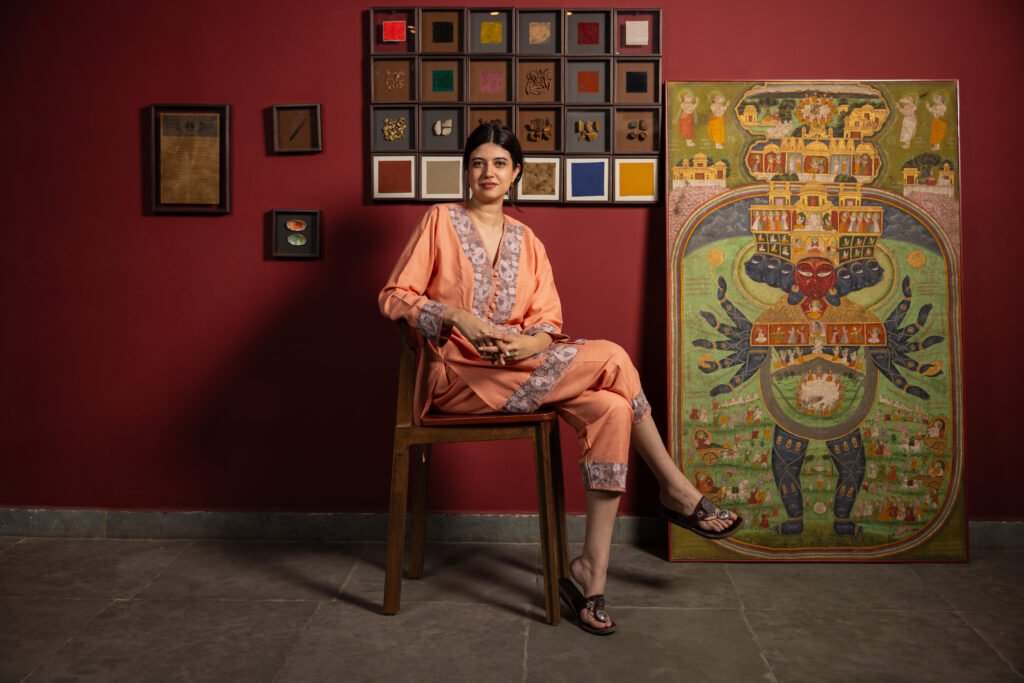
How Bridge Bharat is rethinking the relationship between India’s living craft traditions and the contemporary market.
By Bhavya Balamurali
Bridge Bharat came into existence because of a gap Aakanksha Singh kept running into. While most people building a heritage art company talk about revival, Singh, who spent her early career reading balance sheets talks about something less romantic: pricing, provenance, continuity, the machinery that decides whether a technique survives one more generation or quietly runs out of hands to carry it. “India has never lacked artistic talent”, she says. What it has lacked is the systems to carry that talent forward. The Gurugram based founder has built a business around exactly that gap, giving centuries old techniques the infrastructure to survive contact with the contemporary market, the kind, fashion and jewellery built for Indian craftsmanship years ago, and that wall art never had.
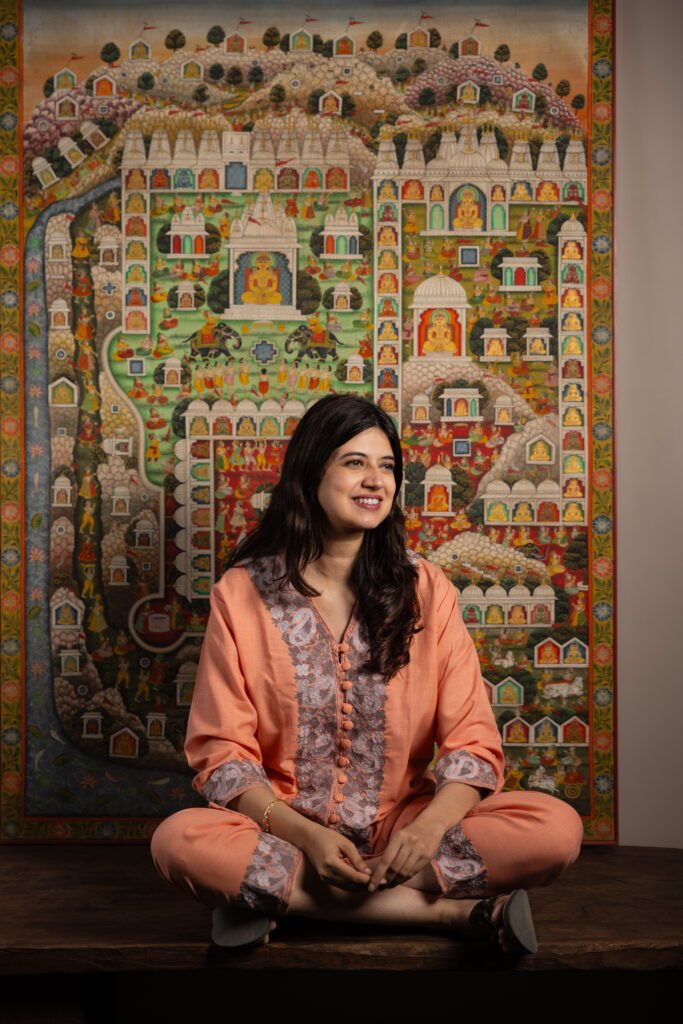
Aakansha Singh
That gap, for Singh, was never purely a business observation. Long before Bridge Bharat existed as a business, it existed as a habit of noticing. As an Air Force kid moving cities every few years, Singh grew up watching art exist inside each new home without being curated or explained, doing its quiet work alongside daily life rather than sitting apart from it as something to be admired. That habit resurfaced years later during a field study on Chamba Rumal embroidery, which put her in direct contact with artists and gave shape to what she had been circling for a while: how to bring traditional Indian craft back into the home it had once belonged to. Incubated at IIM Ahmedabad’s programme for creative and cultural businesses and founded in 2022, Bridge Bharat was built to be the layer between master artists and the contemporary market.
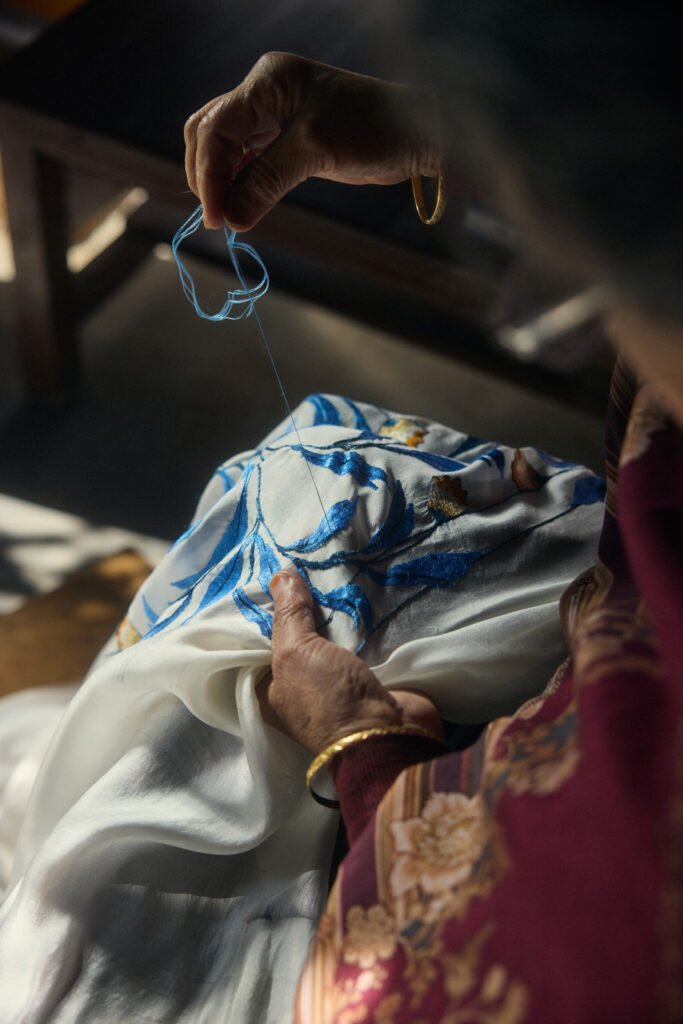
Chamba Rumal via Bridge Bharat
Bridge Bharat has positioned Aakanksha Singh among a new generation of young entrepreneurs building businesses around cultural cause rather than category, the kind of company where profit and preservation are meant to move together.
In conversation with ACF India, Singh talks about the growth metrics and what it actually takes to add something durable to India’s art ecosystem.
ACF INDIA: Tell us the story behind founding Bridge Bharat, how did it all come together?
Aakanksha Singh: I grew up an Air Force kid. That meant a new city every few years, new schools, new languages, and new ways of belonging. You learn quickly that communities don’t run on force; they run on systems, routines, roles, and unspoken codes. What stayed constant through every move was the art inside our homes. Nothing curated, nothing explained. Just paintings and craft objects, deeply present, part of daily life rather than objects of display. Years later, living in more modern homes, open, minimal, and light-filled, I noticed a disconnect. People still loved Indian art, but it no longer sat comfortably on their walls. It got called “too busy” or “too traditional,” which sounded like a taste problem but wasn’t. Indian art was never made for white walls and open floor plans. It lived in temples, havelis, and courtyards: thick walls, low light, and deep thresholds. Our homes had changed completely. Our presentation of Indian art had not evolved in tandem. This realization sparked a desire to bridge that gap, to find a way to integrate the vibrancy of Indian art into modern spaces without losing its essence.
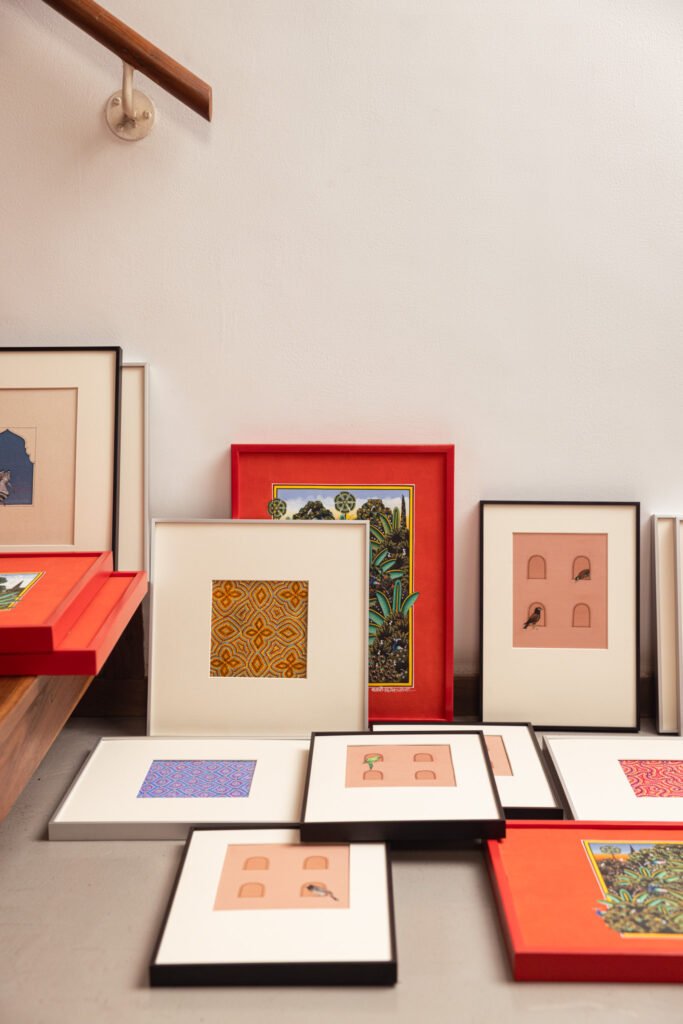
I began exploring innovative display techniques that honoured the artwork’s rich heritage while making it feel at home in contemporary environments. Respect for the art wasn’t the missing piece; deliberate system-building was. That insight sharpened while I was leading a research initiative at Digital Desh, working with MSMEs across India. A field study on Chamba Rumal embroidery put me in direct, extended contact with artists of extraordinary skill with no organized way to translate into today’s markets. That gap, between heritage craft and modern systems, is what became Bridge Bharat. We began operations in December 2023, after fieldwork through the COVID years. The starting premise was simple: India has never lacked artistic talent. What it has lacked is infrastructure. Not a gallery. Not a marketplace. Bridge Bharat is a cultural infrastructure company, the missing middle layer between master artists and global luxury markets, translating centuries-old techniques into contemporary, site-specific work without diluting what makes them original.
ACF INDIA: You came from a finance and investment background yourself. What made you look at heritage art specifically and think, this is worth investing in?
Aakanksha Singh: My background trained me to look for structural gaps, not surface-level ones. In finance, you learn quickly that talent without systems does not compound. It just resets. That is exactly what I saw in Indian craft. Extraordinary skill, passed down for generations, but no pricing consistency, no archives, no scale logic, and no reliable bridge into global luxury markets. Fashion and jewellery had already proven that Indian craftsmanship travels. Wall art had never been given the infrastructure to do the same. Once I saw that gap clearly, it stopped being a cultural interest and became an obvious investment case.
ACF INDIA: We’re seeing younger generations get active around conversations on art like never before. Why do you think that’s happening now, and what do you think they’re actually looking for in it?
Aakanksha Singh: I’d push back gently on the framing that it’s about “art” in the gallery sense. What I see is a generation that grew up with infinite, frictionless, placeless consumption and is now actively looking for things that, a feed can’t replicate. A hand-embroidered textile carries three months of one person’s labour in a way a print cannot fake, and an algorithm cannot generate. That specific person, this exact cluster, this exact technique is the actual commodity right now, more than “art” as a category.
What they’re looking for isn’t ornamentation for a home. It’s provenance as a form of meaning-making, a way to furnish a life with things that have an origin story you can actually stand behind, rather than things that signal taste without substance behind the signal. The craft object gives them something a luxury logo can’t: a specific human being on the other end of it.
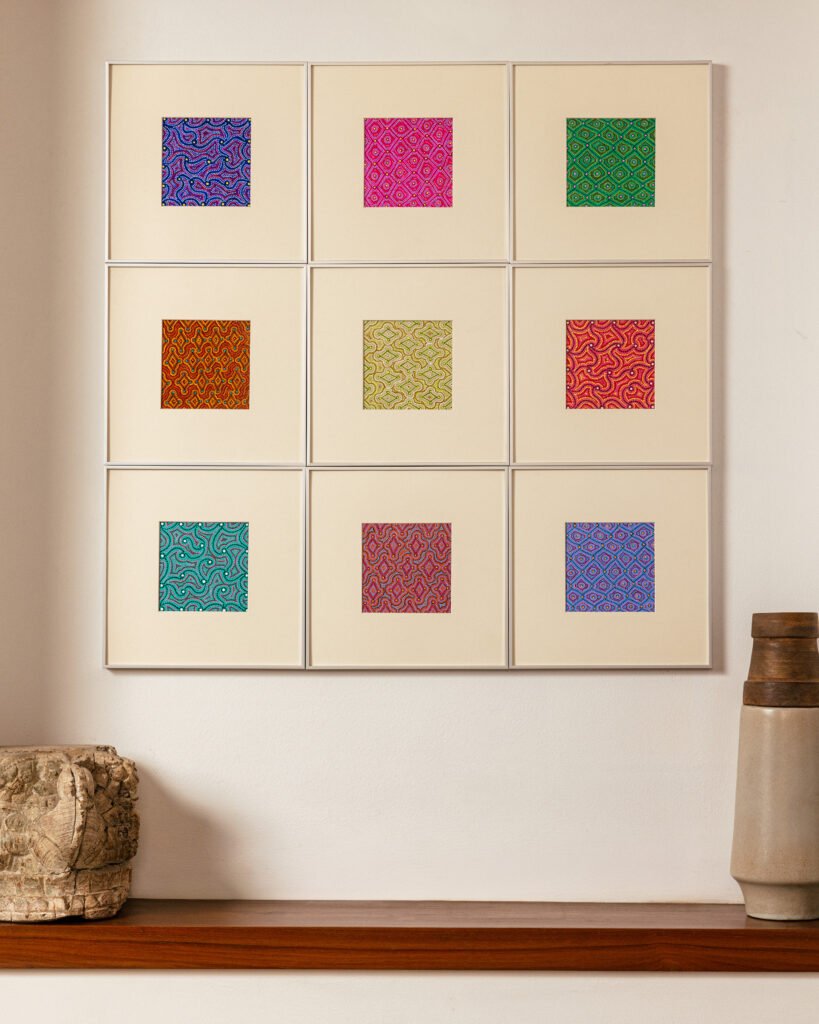
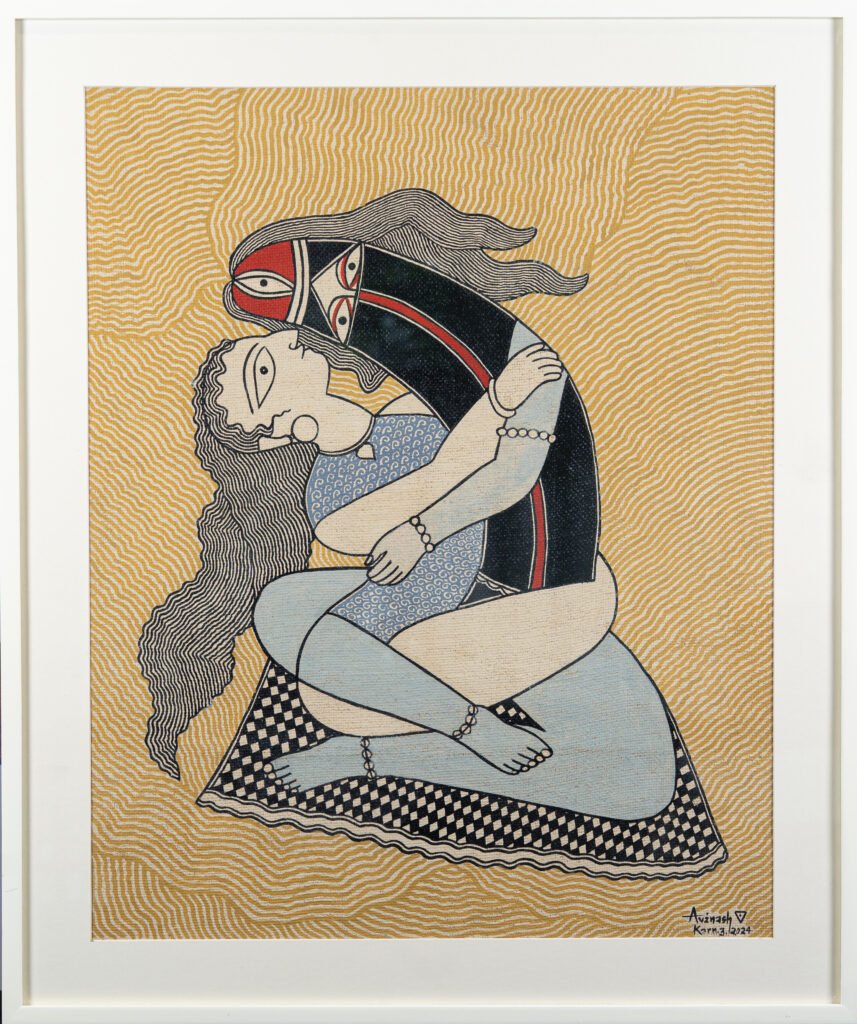
ACF INDIA: You’re essentially asking 500-year-old techniques to survive inside 2026 living rooms. Is there anything that gets lost in that translation?
Aakanksha Singh: Yes, and I think it’s dishonest to pretend otherwise. What gets lost is context. A Mata ni Pachedi was never meant to hang flat and framed; it was a temple textile, made in devotion, read within a ritual grammar most collectors today don’t have access to. When you bring it into a living room, you strip away the original function, and you’re left with the visual grammar alone.
The question is whether you’re honest about that loss or whether you paper over it with vague heritage language. Our approach is to make the translation visible rather than invisible, to tell people plainly what’s been kept and what’s been let go, rather than selling the illusion that nothing has changed. Replication of the pattern is tradition. Replication of the original context is where translation, honestly, ends. We’d rather say that out loud than pretend the object still means exactly what it meant on a temple wall in Ahmedabad two centuries ago.
But I don’t think it’s a clean loss, either something real gets gained, and it’s not just “exposure” or “livelihood,” though both of those are true. What’s gained is a second life for a visual language that was, in its original context, only ever seen by whoever walked into that specific temple. A Mata ni Pachedi made for devotion had an audience of one community, in one place, for as long as the cloth survived. The same visual grammar in a living room today is seen by people who will never set foot in Gujarat, who will ask questions about the Chitara family’s technique that a devotee inside the ritual would have no reason to ask. That’s not a lesser form of attention; it’s a different one. Devotion doesn’t require you to understand how the hand made the line. A living room does, if the object is going to earn its place there, rather than just decorate it.
The other thing that’s gained, and I think this one matter more long-term: economic legibility. A temple textile inside its original function was never a commercial object with a price that reflected the actual skill in it; it was made, gifted, used, and eventually replaced, outside any market that valued the artist’s hand specifically. Bringing it into a contemporary space, done honestly, is what lets us finally put a number on what that hand is worth, which is the only thing that keeps the Chitara family’s grandchildren doing this instead of something else. The ritual object never had to survive economically. The living-room object does, and that pressure, uncomfortable as it sounds, is what’s actually kept these techniques alive in this generation rather than the last.
So, the honest version of the trade isn’t loss versus gain, it’s a translation with real cost on one side and real range on the other. We just don’t think you get to claim the gain without naming the cost first.
ACF INDIA: In the process of finding artists practicing traditional art forms, have you ever encountered an artwork that was on the brink of disappearing simply because there was no awareness around it?
Aakanksha Singh: Awareness is almost never the actual bottleneck that’s the comforting version of the story. What’s usually on the brink isn’t the technique, it’s the economics around the technique. A craft doesn’t disappear because nobody’s heard of it; it disappears because the next generation in that family does the math and realises, they can earn more doing something else, and nobody can blame them for that.
What we’ve seen more specifically is techniques narrowing at the level of the hand rather than the pattern a family that could once execute five variations within a form now executes one, because there’s only demand (or only teaching time) for the version that sells. The pattern survives; the range of what a hand could do inside that pattern quietly shrinks. That’s a harder thing to notice and a harder thing to reverse than outright disappearance, because nothing visibly ends. It just gets thinner.
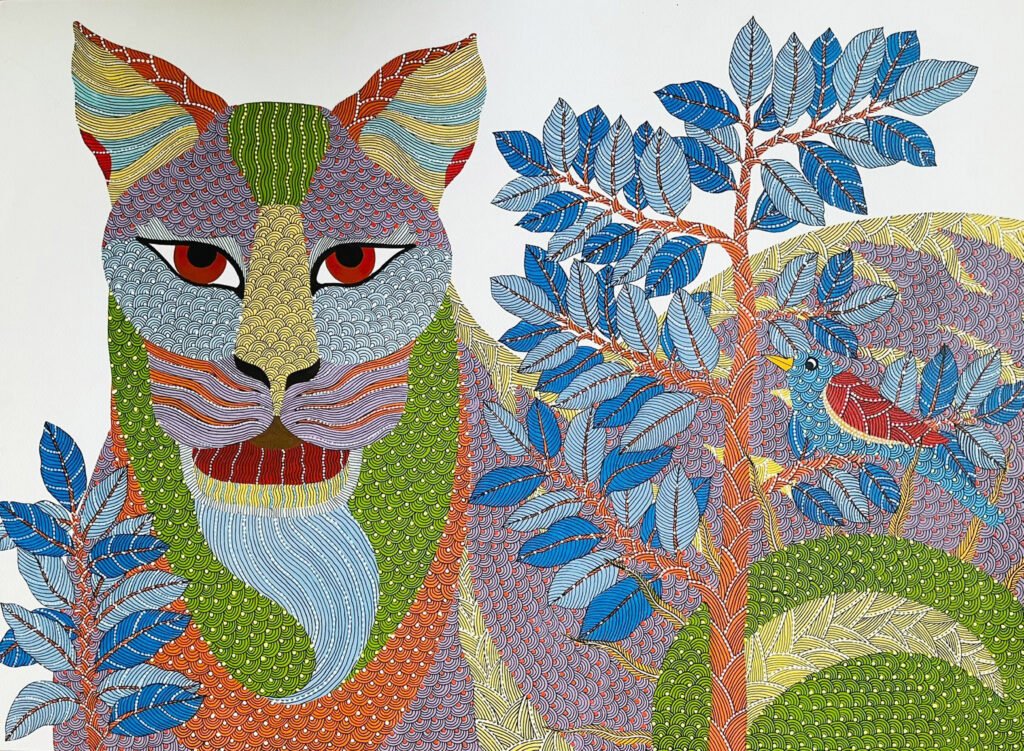
Gond Painting commissioned by Bridge Bharat
ACF INDIA: Has Bridge Bharat run into knockoffs or unauthorized copies of the artists’ work — and is that something you actively fight, or something you’ve had to make peace with?
Aakanksha Singh: Both, honestly, and I think pretending it’s purely one or the other is where most heritage brands lose credibility. Pattern replication is close to unstoppable: a motif, once photographed, is functionally public the moment it’s on the internet, and Indian craft traditions have always had permeable boundaries between “tradition” and “original,” so I’m not going to pretend we’re the first people to claim purity there.
What we do fight for, because it’s the actual point of leverage, is the distinction between the pattern and the hand. Anyone can screen-print a pattern. Nobody can mass-produce three months of kantha stitch or the specific tension of a particular embroiderer’s hand. So, our energy goes into making that distinction commercially legible to the buyer: pricing, storytelling, and provenance that make clear what they’re actually paying for isn’t the motif; it’s the person. That’s a harder fight to win in court and a much more winnable fight in the market.
ACF INDIA: Is Indian traditional art actually finding its way into more contemporary spaces, or is that still more talk than practice on the ground?
Aakanksha Singh: Both are true at once, at different points in the pipeline. At the top of the funnel are interior designers and taste gatekeepers; the appetite is real, and it’s grown fast. Designers are actively looking for Indian craft as a differentiator, not a compromise, which wasn’t true even five years ago.
Where it’s still mostly talk is at the transaction layer. The infrastructure to actually buy, price, and scale these objects the way you’d buy any premium product, with consistent quality control across a craft cluster, reliable timelines, an actual catalogue instead of one-off commissions is still thin. So, you get a lot of correct sentiment and not enough operational plumbing underneath it. That gap is, frankly, the business we’re building to close. The demand side has arrived. The supply side is still being built, cluster by cluster.
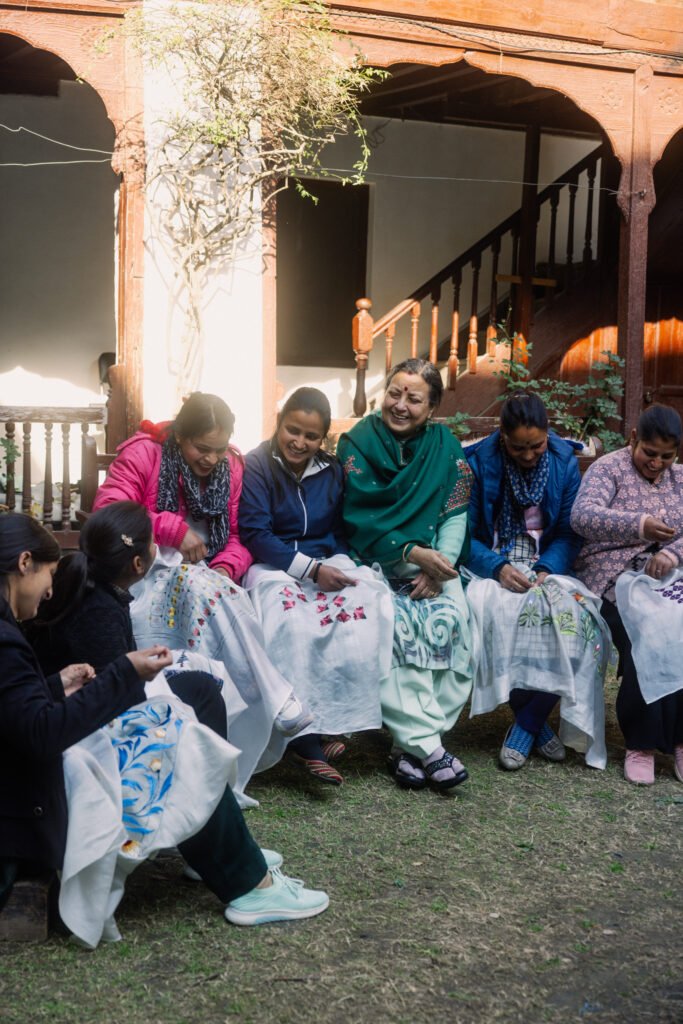
Lalita Vakil with her team via Bridge Bharat
ACF INDIA: What’s a piece of art you own that you love?
Aakanksha Singh: It’s a Chamba Rumal by Lalita Vakil, a piece we call River Bed from Bridge Bharat’s first collection – Fields of Chamba, embroidered on silk. Lalita Ji is a Padma Shri awardee, one of the people who kept do-rukha embroidery from disappearing entirely after it lost royal patronage post-Independence, and she’s since trained hundreds of women in it, some now in their third generation.
River Bed maps the actual topography of the Ravi, the river that runs through Chamba, where this craft has always been made. Chamba Rumals traditionally carried mythological scenes of Krishna’s life, court hunting scenes but the landscape underneath those scenes was never incidental; the valley and the river the artists actually lived beside worked their way into the composition as the ground the story sat on. What Lalita and the Bridge Bharat team has done with this piece is let that ground be the whole subject rather than the backdrop; the river’s own meander, rendered as line, is the entire composition, with no narrative scene layered on top of it.
The technical fact about do-rukha is that it’s worked so the front and back are both finished with no knots, no traveling threads, no wrong side. When you first look at it, that reads as a nice piece of trivia about craftsmanship. What you actually notice only after living with it for a while is that the piece behaves differently depending on the light and the angle you catch it at, because there’s no “correct” side dictating how the thread lies the density of stitching is identical on both faces, so it doesn’t have the slight directional sheen most embroidery has when light hits the grain of the thread from the “back.” It just sits flatter and quieter than embroidery has any right to.
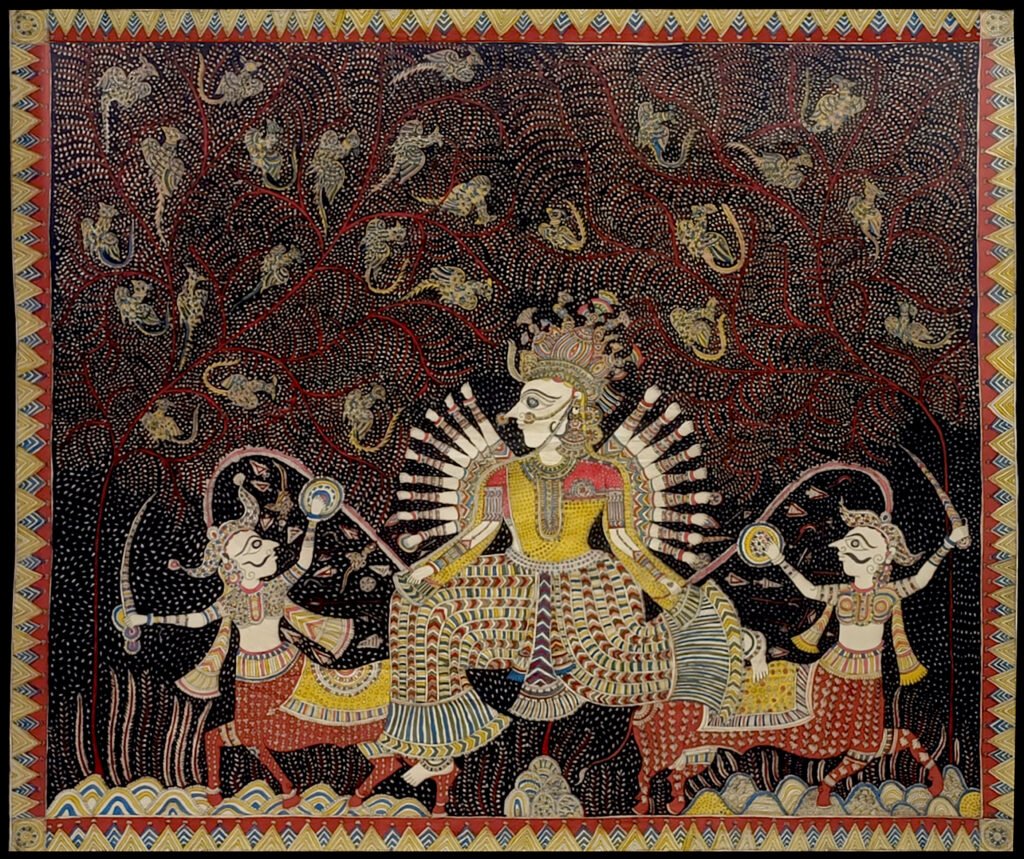
Mata ne Pachedi commissioned by Bridge Bharat
ACF INDIA: As someone exposed to so many traditional art forms through this work, what’s your personal favourite and why?
Aakanksha Singh: If I’m honest, it’s Sohrai, the mural tradition from Hazaribagh in Jharkhand. And it’s not the favourite I expected to have, because on paper it’s the least “decorative” of everything we work with. There’s no fine brush, no gold work, none of the technical virtuosity that usually gets called out as impressive. The tools are bruised sal sticks and swabs rather than brushes, and a lot of the actual mark-making happens with chewed twigs, cloth, or bare fingers. What draws me in is exactly that refusal of preciousness; it’s an art form that has never once tried to look expensive.
What holds my attention technically is the discipline underneath what looks like freehand intuition. The palette is entirely mineral manganese for black, white clay, red ochre, yellow ochre mixed directly into the mud rather than applied as paint over a surface. The wall isn’t a canvas the pigment sits on top of; the pigment and the wall are the same material system. That’s a completely different relationship to surface than almost anything else we work with, where you’re usually looking at pigment or thread applied to a base. Here the base and the image are the same substance, which means the painting is only ever as permanent as the wall itself; it’s meant to be redone, not preserved.
And then there’s the part that actually got me: it’s a matriarchal tradition, passed from mother to daughter, and it sits alongside a sister tradition, Khovar, done at weddings, using a completely different technique two layers of clay applied dark-under-light, then scraped back to reveal the pattern underneath so the same community holds two entirely different technical logics for two entirely different life events: harvest and marriage, addition and subtraction. That kind of built-in vocabulary where the how of the making changes with the occasion, not just the what is the thing I keep coming back to. It’s not a style. It’s a system for saying different things with your hands depending on what’s actually happening in the house.
There’s also a continuity to it that I don’t think gets said enough: the same motifs and mark-making logic show up in the prehistoric rock art at the nearby Isko caves so what you’re looking at on a wall today isn’t a revival or a reconstruction. It’s a living line running back further than almost anything we work with. That’s a different kind of favourite than “I find it beautiful.” It’s more that I find it honest about materials, about occasion, about impermanence in a way most traditional forms, once they’re commercialised, stop being.