
How One Dot Became a Modern Masterpiece
By Faith Mozhui
Have you ever felt like your brain was on overdrive with a thousand tabs open and running at the same time? Late legendary artist Sayed Haider Raza felt the same. And what did he do about it? He painted. Raza realized that sometimes the most profound answers aren’t hidden in complexity but instead they’re found in the simplicity of a single point.
S.H. Raza was one of the founding members of the Progressive Artists’ Group founded in the 1940’s. He was known for painting evocative landscapes during his early career and experienced an artistic awakening after spending decades living a bohemian lifestyle in Paris. Having mastered the art of capturing landscapes he sought for something more. That search led him to the Bindu, and its origin story is nothing short of magical.
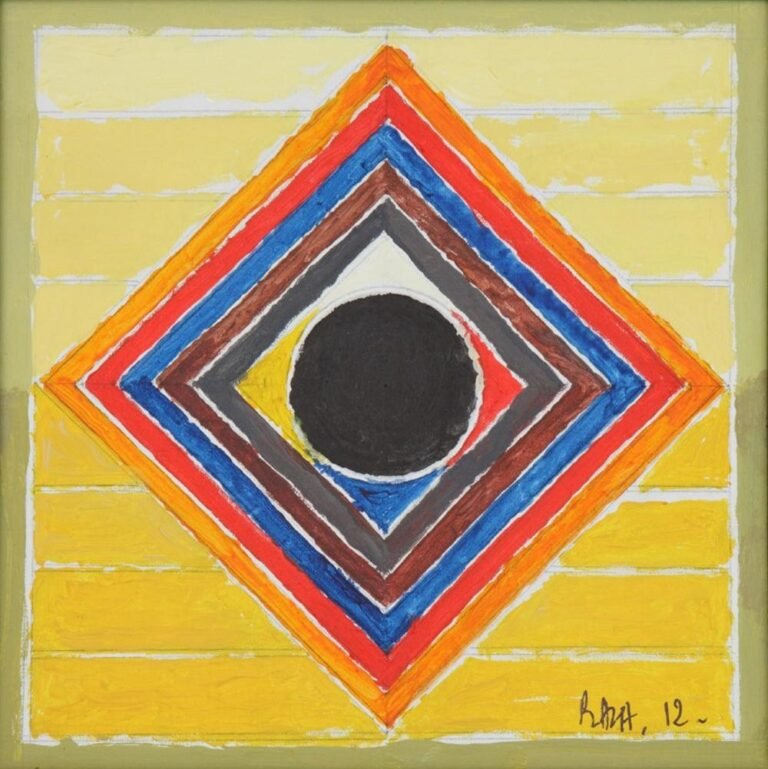
For Raza, the Bindu stopped being just a mark on a page; it became the heartbeat of his canvas. It represents the point where everything begins and ends, a silent anchor that helps you stop worrying about all the noise around you and to pause for a minute and just breathe. When you look at a piece painted by Raza, you immediately notice that the colors on his canvas come alive. He operated with a sophisticated color theory inspired by the Panchatatva, the five ancient elements: Earth, Air, Water, Fire, and Space. He favored high-voltage, saturated tones like the deep, midnight blacks, intense burning reds, electric blues, and brilliant, sunny yellows. His compositions were not just some random splashes of paint; they were meticulously engineered houses for the Bindu. By layering triangles to symbolize masculine and feminine energies and using squares to anchor the design, he transformed complex philosophical ideas into vibrant, glowing works of art.
Perhaps the most fascinating thing about Raza is how his art continued to evolve even in his final years. He didn’t just stick to one way of painting but constantly experimented with new textures to give his works a sculptural, almost three-dimensional feel. He wanted the viewer to not just see the art, but to feel the physical weight and energy of it. This relentless curiosity meant that his “Bindu” was never the same twice, it was always evolving. It shows us that true mastery isn’t about finding one perfect answer and stopping, but about finding a central theme and allowing it to grow and change alongside you as you navigate life.
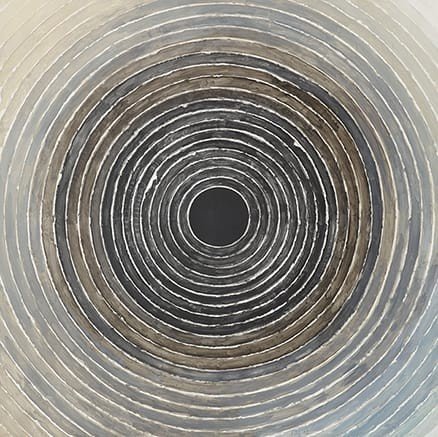
In today’s world where our attention is pulled in a thousand directions every second, where chaos is the norm and noise are constant, Raza’s work serves as a quiet reminder to slow down. He practiced a form of deep, soulful minimalism long before it became a popular lifestyle trend. He proved that you don’t need a canvas overflowing with details to convey something truly profound. Sometimes, the most powerful statement you can make is a perfectly placed circle.
Whether he was capturing the spiritual energy of the Kundalini or drawing inspiration from the epic tales of the Mahabharata, Raza’s work was always a quest to find the quiet, steady center in a world that never stops moving. His legacy teaches us that even when life feels fragmented, we have the power to draw our own center. So, the next time you feel overwhelmed, maybe skip the doom-scrolling. Instead, picture a vibrant, glowing Bindu sitting right at the center of your screen, take a long, deep breath, and try to channel your inner Raza.
Hailing from Nagaland, Faith holds a Bachelor’s degree in English from Kohima Science College and a Master’s in Mass Communication. A creative at heart, they are passionate about art and cultural heritage and exploring the relevance of tradition in contemporary society.