
Northeast India's Folk Theatre: How it Outlived its Oppressors
– Bhavya Balamurali
In the northeastern corner of India, where rivers run older than memory, the emergence of folk theatre was more of a necessity than entertainment. The quiet desperation of communities and the political upheaval which caused crack in the society was the genesis of the performance tradition, which helped people hold onto who they were in the face of forces that sought to reshape them.
The folk tradition of northeast is not the kind of story you read in a library, rather they were passed down through body, voice and the breath of a gathered audience, with the story of its origin tracing back to the conscience of its people.
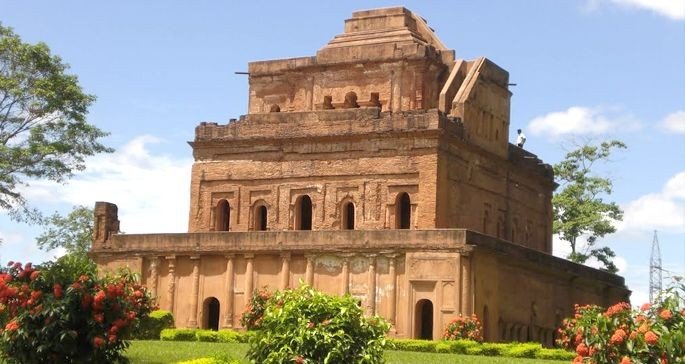
In 15th century Assam, when Ahom Kingdom was politically restless, Srimanta Sankardeva devised a solution to fix the spiritual fragmentation. During this time, which historians call the Neo-Vaishnavite period, the saint, poet and reformer, Srimanta Sankardeva, derived the essential for the revival. The intent came from the thought that, the most effective vessel for an idea is not a sermon but a story made flesh. This led to the invention of Ankia Naat, which was a one act play performed in a constructed literary tongue called the Brajbuli, a fluent blend of Assamese, Maithili, Braj and Sanskrit which helped simultaneously transform the scared into something intimate and elevated. Sutradhara who is the narrative figure in Ankia Naat anchored each performance, helping weave the audience into the world of play. At the heart of Ankia Naat was the life and childhood of Lord Krishna, rendered with music, movement and verse.
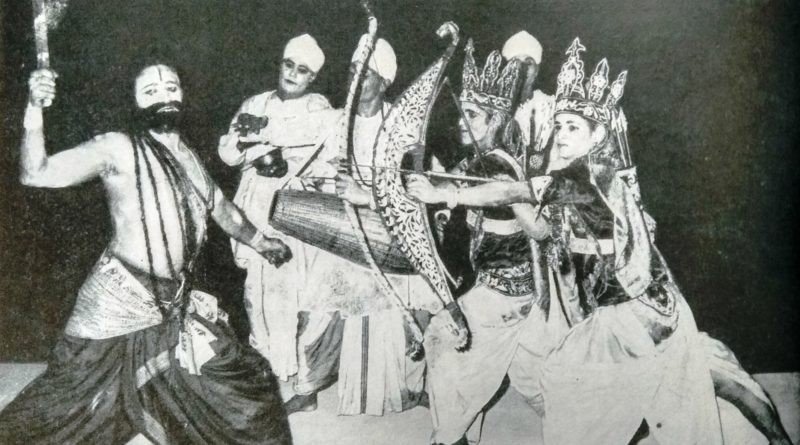
If we look at the architecture of Sankardeva’s theatre, we can identify how he made it radical through the artistry and access. He fused devotion with theatre, by performing it in Namghars and Satras, which were the community prayer halls that functioned as much as a village gathering space as a place of worship. He brought spiritual reform to the people rather than asking people to come to it. Ankia Naat evolved to be something you inhabited, The Bhaona, as the staging came to be called captured the essence of the artform.
Even centuries later, Ankia Naat continues to be staged in these same spaces, existing as a living practice of a tradition alive instead of a museum piece. An entire cultural ecosystem grew from a single man’s understanding that art could do. The influence of Ankia Naat gave rise to Sattriya Naat and the broader tradition of Sankari music.
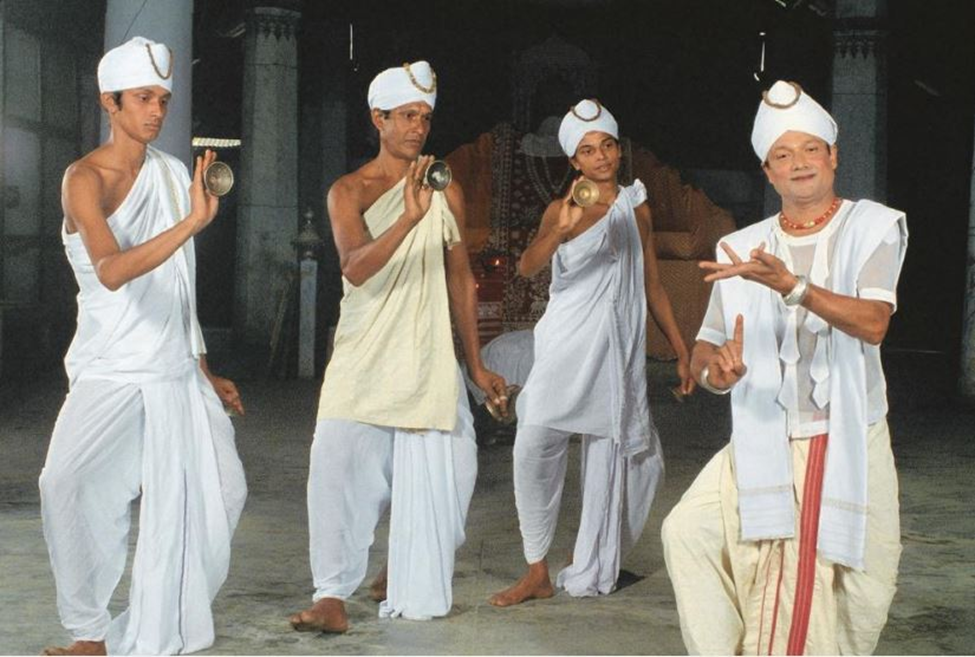
Along the traditions in Assam is the Ojapali which is a much older, more intimate form of narrative performance in which the great epics of Ramayana and Mahabharata is told by the lead performer, the Oja, who is surrounded by the Pali performers whose chorus echo, fill and respond to him. By inhabiting the narrative, the Oja does not merely recite, they shift between characters, commentary, songs and help in transforming the space into a living conversation.
Ojapali is built in such a way that it gives us a sense that the story being told is also being discovered in the very act of its telling, or in short, we can say that, Ojapali gave folk theatre its pulse while, Sankardeva gave folk theatre its architecture.
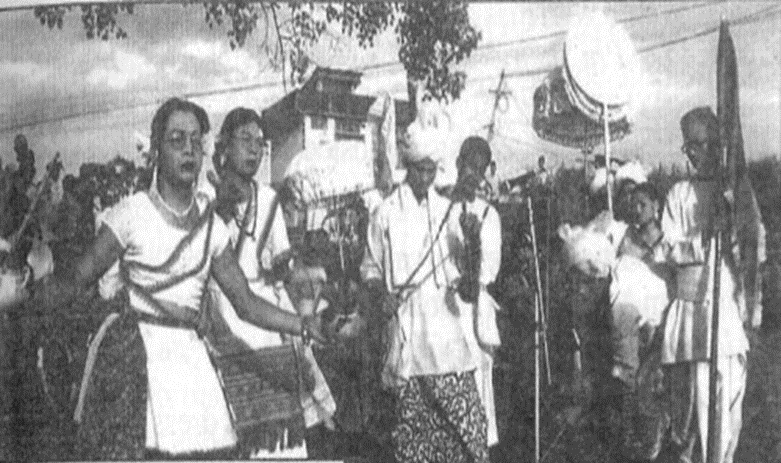
Hundreds of kilometres east in Manipur, the courtyard theatre slowly grew, building its own theatre from the ground up. With its earliest root in Lai Haraoba, the festival of appeasement for the sylvan deities, a form that predates recorded history, it is integrated into the fabric of Meitei spiritual life, through which Jatra Wali took its form. Emerging from this ceremonial soil, and acquiring its name in 1976 as Shumang Leela, Jatri Wali was a courtyard theatre performed in open air, visible and accessible from all four sides. Under the reign of Maharaja Chandrakirti between 1850 and 1866, its earliest form under the royal court was performed in an all-male performance tradition, with men playing female role with extraordinary refinement, from which the form gained its most distinctive visual signature. This ancient form is also derived from much ancient forms such as Phagee Leela or the farce play.
Scholar Ningombam Ibobi Singh traces the origin of Shumang Leela from Phagee Leela which was a sharp tongued and socially observant form. The appetite of social commentary by Shumang Leela can be traced back to this. The Saga of Moirang or the Moirang Parva was the first ever Shumang Leela performed, which tells the legendary love story of Khamba and Thoibi. It was believed to be performed with such intensity, according to the royal family of that time, that cracked appeared on the walls of the Thangjing Temple in Moirang, which caused the performance to be banned shortly after.
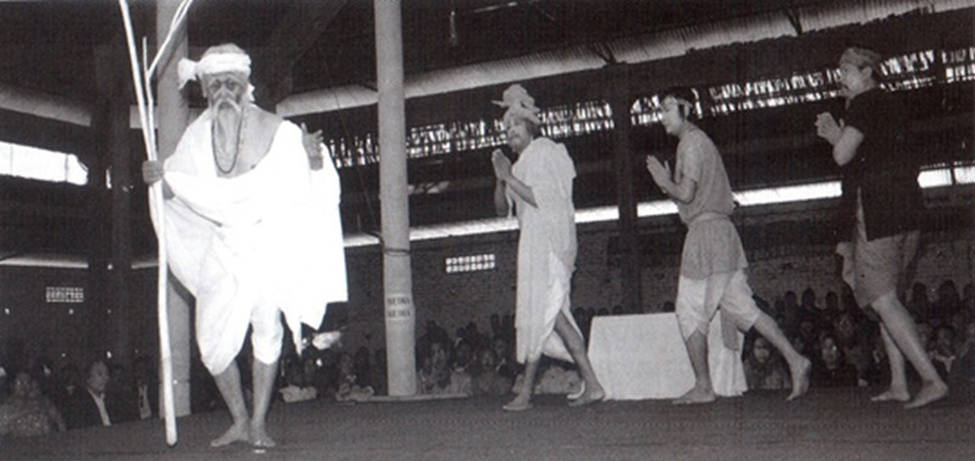
In 1891 when British colonial rule arrived in Manipur, the Meitei people’s cultural life became considerably heavier. The political occupation caused a period of compounded pressure which was combined with a process of cultural Sanskritization. This whole process put the Meitei community and their identity at risk, with their vernacular Meitei tongue being put to a secondary, even impure status. The whole process made theatre more deliberate than entertaining. It was this compounded anger that made one Sanamacha or a master of Manipuri dance and music, channel the emotion of Meitei people into Kabul Leela. Kabul Leela was a protest theatre aimed directly at the exploitative practice of Kabul traders operating in the region, which was performed alongside the older Phagee Leela tradition.
The gap in the history of Shumang Leela between 1895-1918 is in itself a testimony of the cultural imperialism. Even though the tradition falls largely silent in the records, during this time, it serves as evidence to the Bengali cultural imperialism which was carried alongside British colonial administration. The whole process suppressed indigenous performance forms and replaced them with a borrowed theatrical vocabulary. During this period, the dialogues and songs were increasingly assimilated into Bangla, Hindi, Sanskrit, Brajbuli and Maithilli, which had the native tongue nudged to the margins of its own cultural expression
What we learn from these ancient art forms still finding a voice in the modern time is that, when theatre is rooted deeply enough its people, it does not simply disappear, it waits to take form in relevance. The first Shumang Leela with a fully written script was staged in 1950 called Puya Meithaba which meant the Burning of the Puya by N. Angouton. the play was a gesture towards cultural loss and its resistance. The transformation of these traditional forms into a modern theatre format made it take on topics like corruption, gender discrimination and long unresolved tension in the militarized conflict.
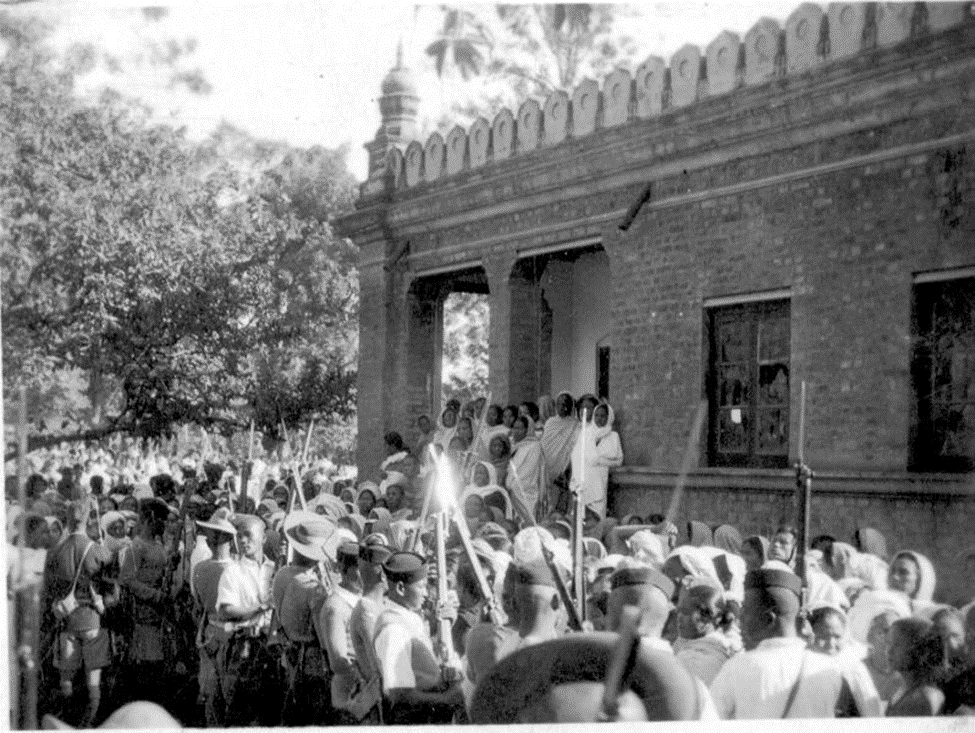
Across centuries, geographies and language, what connects Ankia Naat to Ojapali and Shumang Leela is that they all refused to remain still. These artforms were not ultimately confined into the role of preserving the past but they rather respond to the present. In responding to the present, these art forms play an active part in preserving what the present would eventually become. Bhaona is still performed in the namghar’s in Assam during festival night, the all-male troupe of the Manipuri courtyard theatre still depict the life of female character and bring them to life. These artforms are arguments rather than museums, they are testimonial to the fact every artform has the right to be witnessed, to be understood and to survive.
In a region where, the language, borders, identities, loyalties are so much contested, the stage opens the space where the identities are discussed, performed the most freely and fiercely.