By – Chahat Sharma
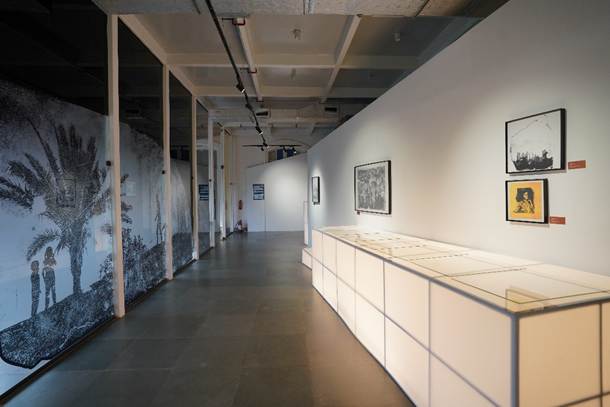
At the Serendipity Arts Festival 2025, photography becomes more than a visual medium, it becomes a mode of listening. Curated by artist, photographer, and environmental activist Ravi Agarwal, Urban Reimagined and Murmurations invite viewers to slow down and attune themselves to the quiet, often ignored frequencies of the city and the earth. Rather than offering spectacle, these exhibitions foreground care, conflict, and the politics of attention, asking what it means to look closely at waste, labour, displacement, and ecological rupture in an increasingly image-saturated world.
Agarwal’s curatorial practice is deeply rooted in long-standing engagements with urban ecologies, social hierarchies, and environmental precarity. Drawing from decades of work at the intersection of art and activism, he approaches photography not as documentation alone, but as an ethical and civic act, one that resists easy consumption and instead insists on presence, responsibility, and listening. At SAF, where exhibitions unfold across public and semi-public spaces in Panjim, this responsibility becomes even more pronounced.
In this conversation, Agarwal reflects on the evolving meanings of the “urban,” the politics embedded in waste and labour, and the challenge of curating attentiveness within a large, diverse festival audience. He speaks about process-driven practices, participatory models, and the quiet power of images that do not announce themselves loudly, but persist nonetheless, like murmurs beneath the surface. Together, Urban Reimagined and Murmurations emerge as acts of civic listening, where photography becomes a site of care, resistance, and shared reflection.
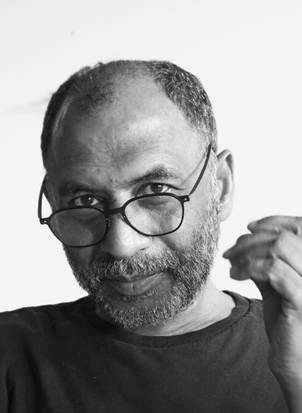
Ravi Agarwal
1. Urban Reimagined is now in its third iteration. Looking back across its different lives, how has your own understanding of the “urban” shifted over time?
The urban has become more complex, and contested. The divide between urban and non-urban is dissolving. Once meant as a melting pot of different narrow identities, it has collapsed into itself, with social hierarchies intact and large ecological footprints beyond. Conceptually the urban has come to acquire different meaning in different social geographies, but has become more an economic space. Recent ruptures caused by technology and the ecology questions have further dissolved these territorial separations, since they extend far beyond the urban. I am not sure if the term ‘urban’ can be universally understood as emancipatory anymore. One thinks more of Gandhi’s suggestion of the distributed village republic, if maybe that could be more emancipatory and ecologically sustainable?

2. Waste is positioned not merely as material residue, but as a marker of caste, class, and invisibility. Do you recall an early encounter (personal or professional) that first made you see waste as a political and photographic subject rather than an environmental one?
Waste for me has always been a deeply political and social subject. In fact environment is only such a space- to think of environment as a technical-economic term is a mistake- It is the same error we make in thinking of the urban. The ‘material’ is not separate- it is located in culture and history. I had worked with waste-pickers for long in the nineties. Most of them do not want to be one, but would rather be in a dignified job- but they are unable to since their caste, class and community identities do not allow them such mobility. I remember one person seeking my help to obtain a simple driver’s license, which would allow him to get a job more respectable job than works as a waste picker. Being a migrant worker, with no permanent address to show he was unable to get one. He was also migrant, as his lower caste family owned no land to till in the village. It is a vicious cycle which continues. That is part of our political economy of labour.
3. Both Urban Reimagined and Murmurations ask viewers to slow down and listen to the city, to the earth, to voices often ignored. In an image-saturated world, how do you curate for attentiveness rather than spectacle?
As a curator, I am interested in practices which are rooted in the social and political, and speak through embodied voices. These resonate quietly, but deeply, like deep earth murmurs. We may not always audibly hear them, but we can feel them with our bodies. Such is the nature of change- quiet, deep, unheard, but persistent and present, driven from the ground up. It cannot be consumed, it is not competing, this is just there- happening, Images or art which appears from such grounds, speaks loudly- and we can only stop and encounter- or not, at our own peril. That is the power of art.
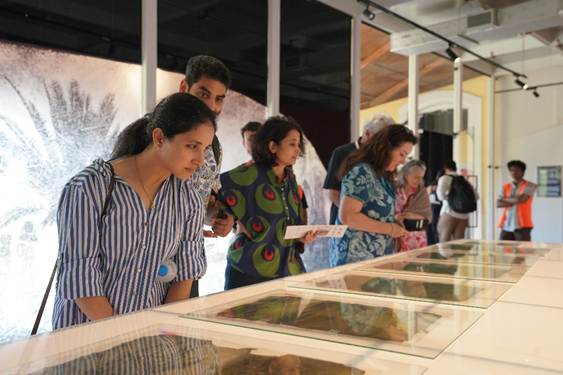
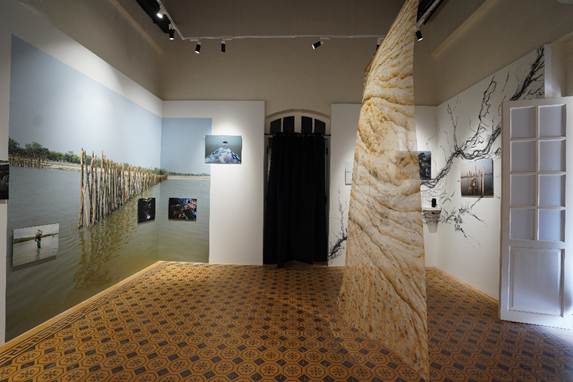
4. Murmurations speaks of “barely audible” rumblings and futures approaching quietly. Were there particular works in the exhibition that surprised you by how softly yet powerfully it spoke?
In fact all of them- and in the show, as I had hoped and intended, they spoke together, and responded to each other- as a murmuration! And so did the participating artists who came there- they became a small momentary like-minded community.
5. The Serendipity Arts Festival unfolds across public and semi-public spaces in Panjim. How does exhibiting photography outside the white cube change the ethical responsibility of both curator and image?
I think the curator has always an ethical responsibility inside or outside the white cube. I believe one has to be able to speak to the audience. In public space, one is intruding into the everyday- and it needs that permission from people to be there- I mean from the ever-present but undefined public. It is the curator’s job then to be aware and understand that space in its social and political dimensions, and communicate. Here the curator’s responsibility is even more, since one is kind of a interloper, even an intruder.
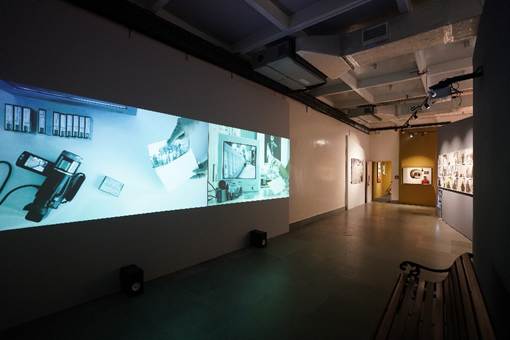
6. Your curatorial practice often sits at the intersection of activism, ecology, and visual culture. At SAF, where the audience is diverse and non-specialist, how do you balance complexity without dilution?
Ultimately, I need to be able to speak about an idea, in all is complexity, through artist’s voices. I frame the concept, invite the artists, but then I facilitate, since I trust my artists. One should never make the mistake of underestimating an audience. People understand layers. And the way they understand is also the openness and possibilities of the exhibition- which I believe should not close something, but open it up. A lot of curatorial work for me is intuitive- experiential learning over time. For me, there is no such term as dilution- only intensity.
7. Rhea Lopez’s counter-mapping workshop feeds back into Urban Reimagined. What excites you about allowing process, participation, and local resistance to shape the exhibition narrative?
Rhea’s proposal was in line with her interest as a radical map-maker, but also which provided opportunities for participants to shift perspective- ways of seeing and knowing land, through listening and observing. One of the challenges of the ecological question, is to unsee/unlearn and shift our gaze, and see differently. Not top down but as a sharing, with more than human beings and the land itself. I was very happy that she agreed to do these walks. I hope it also builds her capacity for taking these ideas forward, and potentially impact many more people. This to me is wonderful- to be able to contribute a little bit for another future with dedicated people like Rhea and through Serendipity! These are unseen pleasures.
8. Finally, after spending years engaging with themes of environmental precarity and social rupture, what still gives you hope and where do you locate tenderness in the contemporary photographic image?
Art gives me hope- especially the kind of practices I engage with. They have the power to shift our understanding through the affective and ephemeral. Change outside starts from change within. Images and works lead us inside, make us aware, challenge our understandings, and open up space for new ideas and possibilities. With our portal open, we can seek new dimensions more actively. There is great power in fragility.
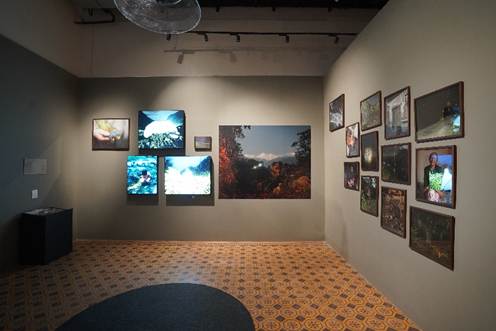
Across this conversation, Ravi Agarwal returns repeatedly to the idea of quiet persistence,of change that does not arrive with force, but gathers slowly through attention, embodiment, and care. Whether speaking about waste as a political marker, the ethics of curating in public space, or the barely audible futures suggested in Murmurations, his reflections resist finality. Instead, they open up space asking viewers, curators, and institutions alike to remain porous, receptive, and accountable.
What emerges most strongly is Agarwal’s faith in art as an affective force. Not as solution, spectacle, or declaration, but as a means of shifting perception from within. In his view, photography holds the capacity to make us pause, to feel before we interpret, and to recognise fragility not as weakness, but as a site of possibility. Change, he suggests, begins quietly through listening, through unlearning, and through the willingness to see differently.
At a moment when cities expand relentlessly and images circulate endlessly, Urban Reimagined and Murmurations offer an alternative rhythm that values slowness, depth, and ethical engagement. In attending to what is often ignored, Agarwal reminds us that tenderness, too, is a form of resistance and that the future may already be speaking, if we are willing to listen.



10 thoughts on “Ravi Agarwal: Curating the Urban Through Care, Conflict and Quiet Resistance”
I like the efforts you have put in this, regards for all the great content.
You’re so awesome! I don’t believe I have read a single thing like that before. So great to find someone with some original thoughts on this topic. Really.. thank you for starting this up. This website is something that is needed on the internet, someone with a little originality!
I am truly thankful to the owner of this web site who has shared this fantastic piece of writing at at this place.
This is really interesting, You’re a very skilled blogger. I’ve joined your feed and look forward to seeking more of your magnificent post. Also, I’ve shared your site in my social networks!
Awesome! Its genuinely remarkable post, I have got much clear idea regarding from this post
I’m often to blogging and i really appreciate your content. The article has actually peaks my interest. I’m going to bookmark your web site and maintain checking for brand spanking new information.
This is my first time pay a quick visit at here and i am really happy to read everthing at one place
Very well presented. Every quote was awesome and thanks for sharing the content. Keep sharing and keep motivating others.
very informative articles or reviews at this time.
Excellent goods from you, man. I have understand your stuff previous to and you are just extremely great. I actually like what you’ve acquired here, certainly like what you are saying and the way in which you say it. You make it enjoyable and you still take care of to keep it sensible. I can not wait to read much more from you. This is actually a wonderful site.