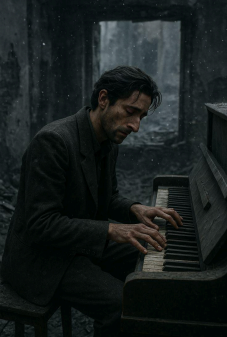
By Gunjan Yadav
The Pianist is not just about the mere existence of art, but about its survival through times so brutal that even humanity seemed to falter. Directed by Roman Polanski, the film channelizes music into a fragile yet defiant force against the brutality of war.
Set in Nazi occupied Warsaw the narrative follows pianist Władysław Szpilman, whose relationship with the piano becomes a metaphor for identity, memory, and resistance.
The Art of Emptiness: Cinematography as Testimony
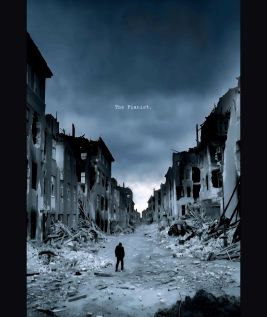
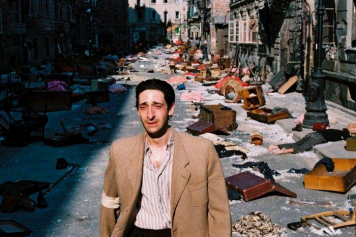
The artistic brilliance of the film lies in its restraint. Polanski avoids dramatic exaggeration instead, he employs stillness, long silences, and a muted color palette of greys and browns.
The city, reduced to ruins feels less like a setting and more like a silent witness to suffering. Buildings stand half destroyed, their broken walls and shattered windows telling stories of lives interrupted. Once lively streets now appear deserted, carrying a heavy stillness that almost feels louder than noise. There are no dramatic explosions dominating every frame instead the film chooses to show war through emptiness.
When Silence Became Music
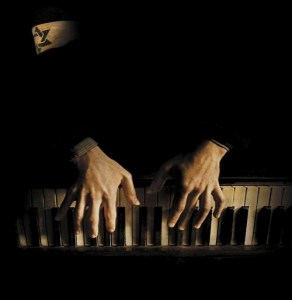
In The Pianist, music is more than just sound; it becomes a source of strength and comfort. One of the most moving moments in the film is when Szpilman sits in front of a piano but does not press the keys, instead he imagines the music in complete silence. Even without sound, we can feel the melody through his expressions. In that quiet moment music becomes something deeply personal and spiritual. The absence of sound paradoxically amplifies its power suggesting that true art resides not in performance but in persistence. It is no longer about performance or audience, it is about holding on to identity and hope.
Hope Through Shadow
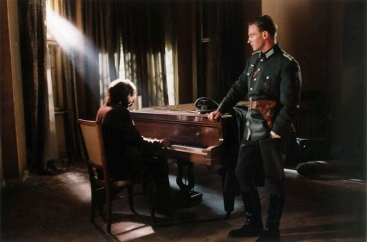
The film’s visual style appears to be inspired by the technique of chiaroscuro, as the deliberate contrast between light and shadow is used throughout the film to heighten emotional and psychological depth. Many scenes take place in dim rooms, where only a thin ray of light enters through a window or broken wall. That small beam of light feels like hope trying to survive in a dark and frightening world. The shadows around Szpilman reflect his isolation and fear, while the light suggests that something within him is still alive.
In the final scene, when music finally returns in full sound, it feels deeply personal and powerful. It is not just a performance on a piano it is a moment of reclaiming self-respect, identity, and dignity after enduring unimaginable suffering.
The Quiet Triumph of Humanity
In the end, The Pianist shows us that art is not just something we create, it is something that helps us survive. Even in the middle of destruction and fear, music becomes a way of remembering who we are. It becomes proof that humanity is still alive. The film gently reminds us that while oppressive powers may try to silence people, they cannot take away the human need to express, to feel, and to create. In this story the piano is more than an instrument. It carries memories, quiet strength, and the spirit of resistance. It stands as a reminder that even in the darkest times, the human soul can endure and sometimes, even triumph.
The Pianist stays with you long after it ends. When Szpilman says, “I’m a pianist” it feels like a quiet but powerful refusal to disappear. This is a film everyone should watch to truly understand survival, silence, and the strength of the human spirit.